robotics education · STEM learning · maker culture · global education
Which Countries Lead in Robotics Education and Maker Culture?
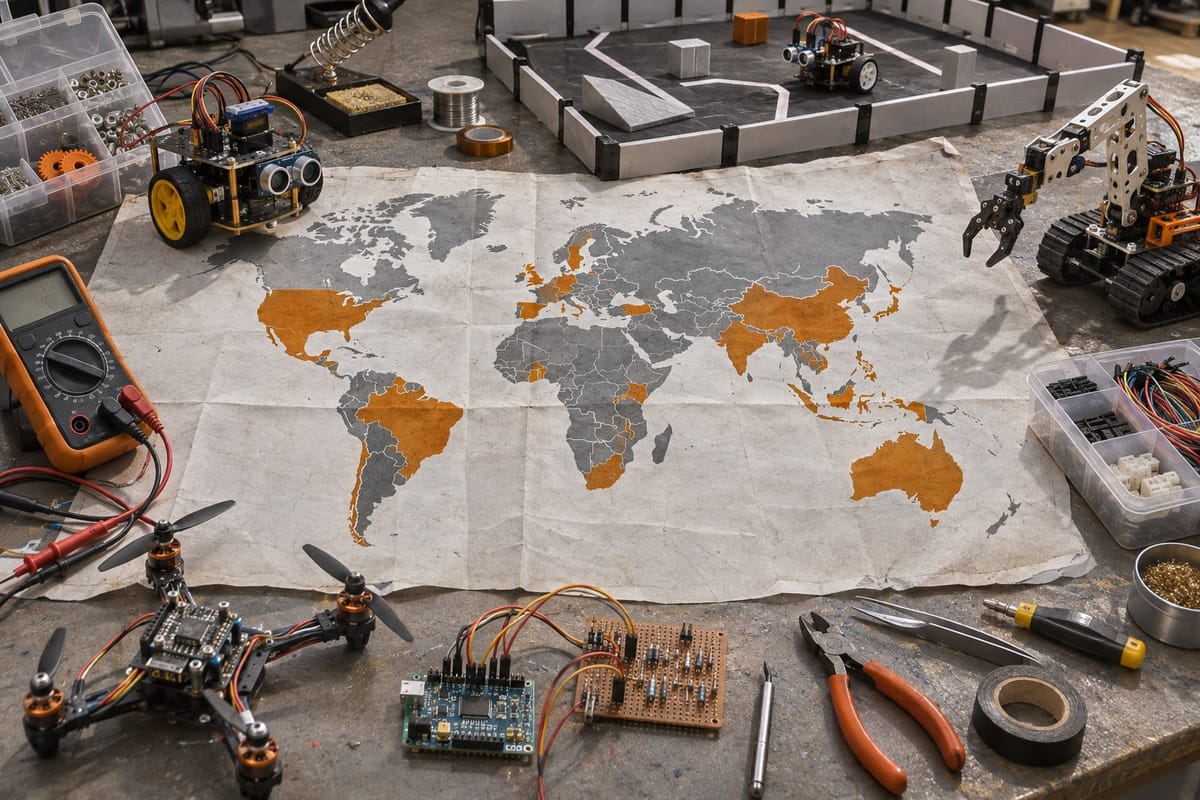
Robotics education has evolved from university electives into primary-school curricula, vocational programs, and nationwide maker movements. The countries leading this shift share common traits: early STEM integration, accessible hardware platforms, and cultural attitudes that treat engineering skill as broadly valuable rather than niche. Understanding where these programs thrive reveals both policy frameworks and grassroots dynamics that any region can adapt.
Japan: Institutional Commitment from Elementary School
Japan mandated programming education in all elementary schools in 2020 and extended it to middle schools in 2021, making algorithmic thinking a core literacy alongside reading and math. The curriculum emphasizes visual programming environments and simple robotics kits, with teachers trained through Ministry of Education workshops. By 2024, over 85% of Japanese elementary schools had integrated robotics activities into science and technology classes.
Commercial and nonprofit sectors reinforce this foundation. Companies like SoftBank and Sony sponsor regional robot competitions, while the Japan Robot Association coordinates school visits and hardware donations. The result is a pipeline where students encounter robotics concepts in grade three and can pursue specialized technical high schools by grade ten, with many graduating directly into engineering roles rather than university programs.
South Korea:競쟁 Culture and Government Funding
South Korea pairs high academic pressure with substantial public investment in STEM infrastructure. The Korea Institute for Advancement of Technology operates over 300 youth maker spaces nationwide, each equipped with 3D printers, laser cutters, and robotics development kits. Access is free or heavily subsidized, and weekend workshops draw thousands of students monthly.
Competition drives engagement. The annual Korea Robot Championship attracts over 5,000 student teams across categories from sumo bots to autonomous rescue vehicles. Universities scout top performers for scholarship programs, creating a clear incentive ladder. This competitive structure mirrors the broader education system, but robotics offers a hands-on alternative to test-focused academics, appealing to students who prefer building to memorizing.
Germany: Dual-Track Vocational Integration
Germany's strength lies in its dual education system, where students combine classroom instruction with apprenticeships in manufacturing and automation firms. Robotics training isn't isolated in computer science tracks—it's embedded in mechatronics, industrial maintenance, and precision manufacturing programs that feed directly into the automotive and industrial sectors.
Technical colleges (Fachhochschulen) offer three-year robotics engineering diplomas recognized across the EU, while Berufsschulen (vocational schools) teach robot programming and PLC operation to students as young as sixteen. The Fraunhofer Institute coordinates industry partnerships, ensuring curricula reflect current factory automation standards. This produces graduates who understand both theory and the practical constraints of production environments.
Maker culture complements formal pathways. Fab labs in Berlin, Munich, and Hamburg host drop-in sessions where hobbyists work alongside engineering students, and hardware suppliers like Reichelt and Conrad maintain tutorial libraries in German. This combination of structured training and accessible experimentation supports both career pathways and personal projects, much like the ecosystem around Raspberry Pi platforms that enable learning at multiple skill levels.
United States: Decentralized Diversity and Private Initiative
The US lacks a national robotics curriculum, but regional variation creates pockets of intense activity. States like Massachusetts, California, and Texas have integrated robotics into public-school electives, while others rely on extracurricular clubs and private programs. FIRST Robotics Competition enrolls over 100,000 high-school students annually, with teams often funded by local businesses and parent fundraising.
Higher education and military investment drive advanced research. MIT, Carnegie Mellon, and Georgia Tech produce cutting-edge work in autonomous systems, while DARPA challenges push the boundaries of mobile manipulation and swarm coordination. However, this research excellence doesn't always translate to K-12 access—well-resourced suburban districts field competitive robot teams with machining equipment and mentor engineers, while underfunded rural and urban schools may lack basic STEM labs.
The US maker movement, anchored by Maker Faire events and chains like Micro Center, supports a strong DIY culture. Online communities and YouTube tutorials lower the barrier for self-taught learners, and the availability of both US-made and imported components gives builders flexibility in sourcing parts. This decentralized model rewards initiative but creates uneven opportunities based on geography and income.
China: Scale, Speed, and National Strategy
China treats robotics education as a strategic priority tied to manufacturing competitiveness and technological sovereignty. The Ministry of Education's 2017 AI and robotics plan called for universal exposure by 2025, and provincial governments have since built hundreds of innovation centers and youth STEM academies. Cities like Shenzhen and Hangzhou mandate robotics modules in middle-school science courses.
The sheer scale is unmatched. China graduates over 1.5 million engineering students annually, many with robotics concentrations, and national competitions like RoboMaster draw arena crowds in the thousands with live broadcasts. Domestic manufacturers produce low-cost kits and components, making hardware accessible even in second-tier cities, and the proximity to Shenzhen's electronics ecosystem means students can prototype and manufacture custom parts rapidly.
Critics note that rote learning persists in many programs, with students memorizing code patterns rather than developing problem-solving intuition. However, elite universities like Tsinghua and Harbin Institute of Technology produce research that rivals any Western institution, and the generation entering the workforce now has more hands-on robotics experience than any cohort in history.
Singapore: Compact, Coordinated, and Future-Focused
Singapore's small size enables policy coherence that larger nations struggle to match. The SkillsFuture initiative funds lifelong STEM learning, including robotics courses for adults transitioning from declining industries. Schools use a standardized Applied Learning Programme that introduces robotics in primary grades and scales complexity through secondary education, with teacher training centrally coordinated.
The government partners with private firms to align curriculum with industry needs. Singapore's advanced manufacturing and logistics sectors employ thousands of robotics technicians, and polytechnics offer fast-track diplomas for roles in automation maintenance and system integration. This tight loop between education and employment reduces skills mismatches and ensures students see clear career paths.
Europe Beyond Germany: Fragmented but Growing
Estonia integrates programming from grade one and has extended this into robotics electives at the secondary level, often using locally developed platforms. The Netherlands and Denmark emphasize project-based learning, with robotics serving as a vehicle for teaching collaboration and iterative design rather than as a standalone subject. Finland's phenomenon-based curriculum treats robotics as one thread in broader interdisciplinary modules.
Eastern Europe shows growing activity. Poland's technical universities have strong robotics faculties, and Hungary's government has invested in youth maker spaces modeled on German fab labs. However, inconsistent funding and teacher shortages limit reach, particularly outside capital cities. EU-level initiatives like Digital Education Action Plan provide frameworks, but implementation remains national or even municipal.
What Drives Leadership: Patterns Across Borders
The leading countries share several enablers beyond curriculum documents. Teacher training is foundational—Japan and Singapore invest heavily in upskilling existing educators rather than expecting computer science specialists to materialize. Hardware access matters equally; South Korea's free maker spaces and China's domestic component production remove cost barriers that stall programs elsewhere.
Cultural attitudes toward technical work shape participation. Germany and Japan treat engineering as a prestigious career path, while in some Anglophone countries, technical roles are seen as fallback options for students who don't pursue white-collar professions. Countries that celebrate making and tinkering—through competitions, media coverage, or vocational respect—generate broader engagement than those where robotics remains confined to academic enrichment for the college-bound.
Industry linkage creates feedback loops. When students see local employers hiring robotics skills, education programs gain relevance and momentum. Germany's apprenticeship system and Singapore's workforce development initiatives connect learning to livelihoods in ways that purely academic programs cannot. Even hobbyist projects benefit when builders know their work could translate into freelance opportunities or startup ventures.
Emerging Players and Future Shifts
India's robotics education is expanding rapidly in private schools and coaching centers, though public-school access remains limited. The atal tinkering labs initiative has equipped thousands of schools with basic kits, but inconsistent implementation and teacher confidence constrain impact. Still, India's large English-speaking population and software talent base position it well for future growth, particularly in AI-driven robotics.
Latin America lags in formal programs but shows grassroots energy. Brazil's Arduino community is among the world's largest, and maker faires in São Paulo and Buenos Aires draw substantial crowds. Mexico's proximity to US manufacturing and reshoring trends may accelerate technical education investment in northern states. However, economic instability and uneven internet access remain barriers to scaling nationally.
Africa's robotics education is nascent but not absent. Rwanda and Kenya have piloted coding and robotics programs in select schools, often supported by international NGOs. South Africa's universities produce capable graduates, but K-12 infrastructure limits the pipeline. Mobile connectivity and falling hardware costs could enable leapfrogging traditional lab models, much as mobile banking bypassed branch networks.
Practical Takeaways for Learners and Educators
Geography doesn't determine opportunity. English-language resources, online communities, and affordable hardware mean motivated learners anywhere can access much of what formal programs offer. Start with platforms that balance cost and capability—battery selection and component sourcing strategies matter as much as coding skill when building functional projects on a budget.
For educators, the leading countries demonstrate that robotics education succeeds when it's hands-on, linked to tangible outcomes, and supported by consistent hardware access. A single well-maintained kit shared across classes beats a closet of broken equipment. Partnerships with local businesses, even small ones, provide mentorship, site visits, and proof that skills lead to jobs.
Policymakers should note that top-down mandates without teacher training and hardware funding produce compliance theater, not learning. Countries that lead have invested in the full stack: curriculum, teacher development, facilities, competitions, and cultural messaging that technical skill is valuable. The returns—workforce readiness, innovation capacity, and inclusive economic participation—justify the expense.